


• Make Your Home Energy and Cost Efficient - FREE 37 Pages of Tips / instant download / no registration
  • Home
  • About Me
  • Disclaimer
  • Virtual Help
  • Partners
    • Home Related
    • For your Home
    • Construction / Remodeling
    • Real Estate
    • Home Inspections
    • Internet Marketing
    • Home and Garden
    • Heating and AC
  • Contact
  • Q&A How to Ask
  • Advertising

Home Maintenance, Remodeling and Repairs

Home maintenance advice, home repairs, remodeling projects for home owners, buyers, from your Illinois home inspector

  • Attic
  • Electric
    • Electrical System Issues
    • GFCI / AFCI
  • Environmental
  • Exterior
    • Free Shed Plan
    • Grading / Drainage
    • House Roof
  • Foundations
    • Crawlspace
  • Garage
    • Car Garage Issues
  • House Maintenance
    • Fall Maintenance
  • HVAC
    • Air Conditioning System
    • Chimney Problems
    • Heating System
    • House Ventilation
  • Inspections
    • Chicago Condo Inspection
    • Crawlspace Inspection
  • Interior
    • Bathrooms
    • House Components Issues
    • Kitchens
  • Plumbing
    • Gas Water Heater
    • Plumbing Problems
  • Recalls
  • Safety
    • Carbon Monoxide
    • Handrails and Guardrails
    • Smoke Detectors
www.checkthishouse.com
You are here: Home / Plumbing / Gas Water Heater / Combustion Air for Fuel Burning Appliances

Combustion Air for Fuel Burning Appliances

  Written by Dariusz Rudnicki     Print This Post   Leave a Comment

Combustion Air

Combustion air is required for all types of fuel burning appliances in our homes to properly burn that fuel.

Combustion air has three functions:

  1. It  is required to properly burn fuel
  2. To dilute exhaust gases that are being vented to exterior
  3. To vent and cool appliances

The most popular fuel used in our homes is of course natural gas.

For every one cubic foot of gas, there are 10 cubic feet of combustion air needed for clean burning in addition to dilution and ventilation air.

There are two products out of a perfectly balanced gas combustion – carbon dioxide and water vapor, which are perfectly safe. However, if we limit the amount of the combustion air in the process,  a third bi-product might develop, unfortunately a deadly one – Carbon Monoxide.

Example:

Imagine a gas water heater in a small closet, behind the solid door, and without any openings in walls providing that necessary combustion air. After using all of the closet’s combustion air for burning process, the air pressure in the closet will become lower than the one inside the water heater’s vent flue pipe.

The water heater closet will pretty much act now like a vacuum and the exhaust gases may be sucked back into the closet space instead of being discharged to the exterior. Since the oxygen starving combustion process is now producing that deadly Carbon Monoxide, it will eventually leak through the gaps around the closet door into the house…

The areas designated for fuel burning appliances are described as confined space and un-confined space.

The water heater closet from my example could be a confined space – an area with a closed, solid door and walls / ceiling that create a barrier between the appliance and the rest of the house, thus not allowing any combustion air penetration.

A confined space is a room that has less than 50 cubic ft of air volume for every 1000 BTU/hr of appliance input .

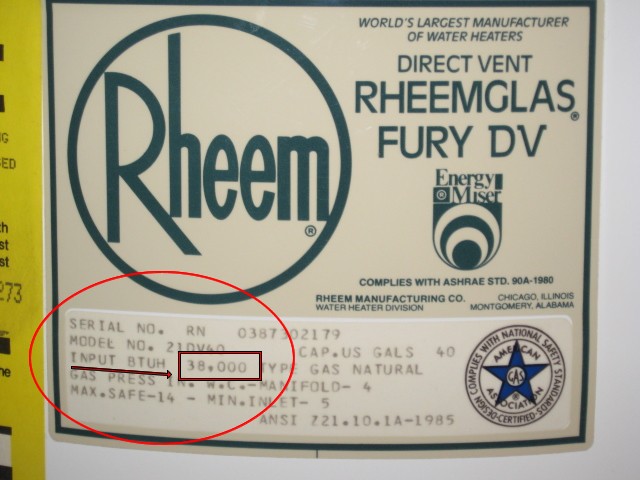
Combustion air amount depends on the appliances BTU's If the water heater has a 40 000 BTU/hr rating, the room would have to have over 2000 cubic feet of volume to provide enough combustion air (without additional sources) for proper burning process.

Un-confined space is a room that has more than 50 cubic ft of air volume for every 1000 BTU/hr of appliance input (BTU/hr input should be on the appliance label / information tag).

Assuming that our example water heater closet itself is a confined space, and it is located in a room being an un-confined space, we would require two openings in the closet door or wall to allow combustion air inside. One opening should be located within 12” from the floor, and second within 12” from the ceiling of the enclosure.

Combustion air ports in the utility room wallOpenings between confined space and unconfined space must have at least 100 sq. inch area each and provide at least 1sq. inch of a free airflow area per 1000 BTU/hr of the appliance input (1/4” min. or larger mesh screen if installed over the openings, metal grills and louvers provide 60%-75% of their net free area, wood louvers only 20%-25%).


With a 40000 BTU/hr water heater input, the combustion process would require only 40 sq. inches of an opening at top and bottom, but you still have to obey the minimum 100 sq. inches per each opening requirement.

Examples of combustion air opening sizes between confined space and un-confined space (inside of the house air)

Up to 100K BTU/hr – 100 square inch openings
125K BTU/hr – 125 square inch openings
150K BTU/hr – 150 square inch openings
175K BTU/hr – 175 square inch openings, and so-forth

Click for house interior combustion air calculations.

More from Home Maintenance

  • House Electrical Panel and the Most Common Mistakes you Make — Home Maintenance, Remodeling and Repairs
  • Combustion Air Requirements for Fossil Fuel Burning Appliances — Home Maintenance, Remodeling and Repairs
  • Chicago Condo Inspection & Combustion Air Requirements

Home Maintenance Recommends

  • Hejduk update  (All Things Colorado Avalanche)
Blog Margeting Related Posts Plugin For Home MaintenanceAsk Home Maintenance To Recommend Your Posts Blog Marketing Related Posts Plugin Counter

  • delicious Bookmark on Delicious
  • digg Digg this post
  • facebook Recommend on Facebook
  • linkedin Share on Linkedin
  • reddit share via Reddit
  • stumble Share with Stumblers
  • technorati Share on technorati
  • twitter Tweet about it
  • yahoo_buzz Buzz it up
  • rss Subscribe to the comments on this post
  • email Tell a friend
Filed Under: Gas Water Heater, Heating System Tagged With: appliance confined space, combustion air, combustion air for fuel burning appliances, Combustion air for water heater, furnace combustion air, furnace confined space, gas appliance combustion air, gas water heater, volume to appliance input ratio, water heater confined space
About Dariusz Rudnicki

I'm a retired Illinois home inspector, founder and editor of checkthishouse.com, a blog which attracts around 2 thousand readers daily and is dedicated to answering the many questions of home owners and home buyers.
Connect with me on Google+

Comment / Ask me a Question Cancel reply

You must be logged in to post a comment.

Sponsored Ads

  • www.checkthishouse.com

***Go to Home Maintenance Q&A section***

Sponsored Ads

.

Home Safety Maintenance

House Maintenance Advice - Vocal Smoke Detector

Smoke Detector Safety Tips – is Your Life Worth at Least $10.00?

Second floor laundry chute mounted on the floor surface with a 9' drop underneath

Laundry Chute Hazard – a Convenient Way to a … Disaster

kidde carbon monoxide

Carbon Monoxide – Toxic Gas Without Taste, Smell or Color

The clothes dryer plastic vent is forbiden, any type of dryer vent should be as short as possible

Clothes Dryer Vent | Why is Dryer Vent Cleaning so Important

Perfect size and one of perfect shapes for the stairs handrail

Stair Handrails and Guardrails Safety Issues

Closet light safety - exposed incandescent light bulb is not permitted, too close to storage, poses fire hazard

Closet Fire | Closet Light Fixture Fire Hazards

Garbage disposal electrical wiring performed with a lamp cord, exposed bare wires, missing connection box cover

Garbage Disposal Wiring | Kitchen Disposal Safety

telesteps-telescopic-combiladder-fully-open

Telescopic Ladders Review – Watch Your Fingers!

Kitchen stove safety - single piece stove anti-tip bracket

Kitchen Stove Safety Anti Tip Bracket

House safety maintenance - climbable balcony guardrails are not permitted - watch your children

Balcony Railing Safety Code | Balcony Guardrails Safe for Children

***Go to Home Maintenance Q&A section***

Like us on Facebook

Search CheckThisHouse.com

Helpful links

  • A UTC Fire & Security Company
  • CDC
  • Consumer Search
  • CPSC
  • Energy Star
  • EPA – Environmental Protection Agency
  • Federal Pacific Electrical Panels
  • Going Green Basics
  • HVI – Home Ventilation Institute
  • IEMA
  • Mesothelioma Center
  • Nicor Gas
  • Peoples & North Shore Gas
  • Permit Place
  • Underwriters Laboratories
  • USFA
  • Zinsco Sylvania Electrical Panels
www.checkthishouse.com

Sponsored Ads

  • If you can see this link so can 1000's of other eyeballs every single day; advertise on checkthishouse.com

Home Maintenance Alexa Stats

Recommend

Recommend [HomeMaintenance]

Home & Garden Blogs
bloglog
Connect with me on Google+

Last 7-days Popular Posts

  • House Water Heater Vent Pipe, How To Do It Right 2444 view(s)
  • Chimney Flue and Furnace / Water Heater Venting 1469 view(s)
  • Getting Rid of Mold in Your Attic| Killing Mold in Attic 637 view(s)
  • Attic Black Mold and Why is it Growing in Your Attic 594 view(s)
  • Code Requirement for Bathroom Vent Location | Bathroom Exhaust 579 view(s)
  • Where to Install Smoke Alarm Detector | Proper Smoke Alarm Location 557 view(s)
  • Attic Ventilation | How Many Attic Vents Your Roof Needs 524 view(s)
  • Plumbing Vent Problems in Your House | Sewer and Drain 509 view(s)
  • Saddle Valve Installation 491 view(s)
  • Carbon Monoxide Detector Alarm Locations | Where to Install CO Detector 437 view(s)

Last searched terms

  • - natural draft water heater
  • - why we use insula(...) line pipe in ac
  • - mold in my attic
  • - roofing cement to seal furnace flue
  • - attic mold removal
  • - how much ventilat(...)style attic need
  • - plumbing vents
  • - electrical box mistakes
  • - where to locate s(...)tors residential
  • - how to get rid of(...)eating air ducts

Visitors Currently Online

  • 05 visitor(s) online
  • powered by WassUp

Search CheckThisHouse.com

Return to top of page

Copyright © 2012 · Home Maintenance · Chicago Web Hosting · All Rights Reserved

  • follow:follow:
  • Become my Facebook friend Become my Facebook friend
  • Connect with me Connect with me
  • RSS RSS
  • Tweet with me Tweet with me
  • Subscribe to my YouTube Channel Subscribe to my YouTube Channel