


Furnace and / or water heater chimney requires proper placement and termination to safely discharge exhaust gases from the appliances combustion (fuel burning) process. Improper chimney placement and termination is often responsible for back-drafts, excessive corrosion of the chimney pipe walls, condensation, and Carbon Monoxide contamination of your house.
The rule explained on the pictures is just one of the several that have to be applied when installing the chimney. Make sure that you have a licensed professional performing gas water heater & furnace flue sizing calculations while replacing or adding any of those appliances in your home.
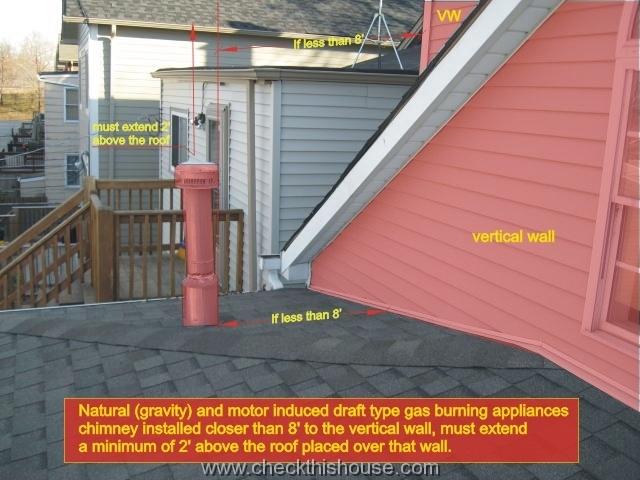
 Natural (gravity) and motor induced draft type gas burning appliances chimney installed closer than 8’ from the vertical wall, must extend a minimum of 2’ above the roof placed over that wall.
Termination (height above the roof surface) of the gas-appliance chimney installed further than 8’ from the vertical wall are listed in the table below (relation to the roof slope). Based on International Residential Code and Uniform Mechanical Code
| Termination of B and BW Vents based on [IRC 2426.6.5] and {UMC T8-1} | |
| Roof Slope | Height above Roof |
| up to 6/12 | 1′ |
| >6/12 to 7/12 | 1’3″ |
| >7/12 to 8/12 | 1’6″ |
| >8/12 to 9/12 | 2′ |
| >9/12 to 10/12 | 2’6″ |
| >10/12 to 11/12 | 3’3″ |
| >11/12 to 12/12 | 4′ |
| >12/12 to 14/12 | 5′ |
| >14/12 to 16/12 | 6′ |
| >16/12 to 18/12 | 7′ |
| >18/12 to 20/12 | 7’6″ |
| >20/12 to21/12 | 8′ |

Hello, I could really use some of your expertise on double wall chimney. I have a 2yr old home and our water heater is directly under our basement stairway and when you open the door to the basement, there is a strong funky odor. On some days it’s strong and on other days there will be very little odor. Now I would like to say that the water heater has it’s own 3 inch double wall chimney with a 45 degree hood on top of chimney and the rest is pretty much all the way up through the roof however on the roof, the top of the chimney cap is not higher than the roofline. Our roof has a 4 and a half, maybe 5 roof slope with no vertical wall(s). Now my question is this what is causing the funky odor when I first open the basement stair case. If so can you explain to me with details, or perhaps am I missing something here. The very top of the chimney cap is about the same level as the roof line , maybe an inch below. I’ll have to go on the roof to be sure about that. Please email me back with your thoughts, comments, and suggestions. Oh, almost forgot. we have a natural gas water heater.
Hi Timothy,
As much as I would like to help you solving this mystery I have no idea what that“strong funky odor” is/means. Carbon Monoxide has no taste or smell and there should be CO detector installed in the basement to alert you about its presence. Natural gas (in case there’s a leak) has a scent added to it so it should be easily distinguishable.
Unless you have something burning inside the water heater vent pipe (or pipe touching some combustible material) there’s really nothing inside the water heater that would give away any odors, it’s a newer appliance so it has a sealed combustion chamber.
One possibility is that there is a fireplace chimney located immediately next to the WH vent pipe and you’ve been using it before opening the basement door. Cold WH chimney may draw air from exterior into the basement… You could also check if there’s any foam insulation on hot and / or cold water pipes in the draft hood area – it could be melting and releasing those odors.
Other than that you’d have to define “strong funky odor”, compare it to some known scent so we can look at different possibilities – sewer gasses, typical basement moisture / lack of ventilation, odors related to sump pump / ejector pump well, etc. Whatever there might be in your basement.
Thank you for repling to my post, first of all, I really can’t describe the smell, but I can tell you one thing is the red and blue plastic grommets on top of the WH where the cold and hot pipes goes into the top of the heater has been melted at one time. To tell you the truth I don’t even know why it did that. I cupped my hand around the hood for a good five minutes while the heater was running and it was fine. But I can tell you that it isn’t plastic that I am smelling and the smell comes and goes. Just to clarify a few things there is no fireplace in my home and we do have a carbon monoxide detector close by the WH and hasn’t went off yet. we do have a high energy effiency furnace next to the WH with a pcv exhaust going out the side of the home. Do you think i could be having, what do u call it, postive and negative air pressure problems in the basement? You never mentioned anything about my WH chimney not being higher than the roofline. What are the pros and cons about that issue? And also in your post you mentioned lack of ventilation. hmmm.. can you explains ways that I can ventilate the basement? If I was to put in an exhaust fan in the basement , how will that affect the WH chimney? Will that also reduce the home energy effiencies? Afew minutes ago my daughter just got out of the shower and I went and opened the door to the basement and I did get a hint of this “odor” and I do know for a fact that the odor wasn’t noticable before she had taken her shower. Maybe I am going crazy and imagining things but I would like to thank you for yor time and also please reply back with more info. thanks again. Tim
Hello,
If you can’t compare that odor to anything I’m in even worse position to come up with an answer :-).
1. Color rings around the hot & cold water pipes melt if there’s a draft problem and exhaust gasses aren’t venting completely… or at all. Maybe there was something inside your chimney that prevented proper venting.
2. If by 4 or 5 roof slope you mean 4/12 or 5/12 the water heater vent pipe (chimney) must clear the roof surface by 1′ (exhaust opening / openings in the rain cap)
3. Depending on your high efficiency furnace setup: if you have 2 PVC pipes attached to the furnace and going to exterior (or two going into one concentric) than the furnace uses exterior air for combustion / doesn’t require air from within your basement. If there’s only one PVC vent pipe (no air intake) the furnace and WH use interior air for combustion. In that case you can calculate required air volume using this formula:
(Total BTU per hour input of all appliances – check their tags for values) x (50ft³) / (1000 Btu/hr) = (Minimum room volume to be classified as an unconfined space / containing sufficient amount of air volume to support clean combustion of your appliances)
There’s more here: https://checkthishouse.com/3518/chicago-condo-inspection-combustion-air-requirements.html
4. I honestly have no idea if you have positive or negative pressure in your basement. It depends on your air supply ports, registers, their dimensions, combustion air requirements of appliances, windows, doors, gaps / drafts, etc.
5. Putting exhaust fan in your basement would most likely create a vacuum effect which may compromise appliance venting. It will also remove your conditioned air. You need fresh air but we usually get that by opening doors and windows. You also need air circulation, some kind of air exchange between the floors (vent ports in doors or floor would help). Properly designed HVAC system with returns and supply ports in each room of the house could do that but I know nothing about yours.
You may consider hiring an experienced home inspector to go over your house and answer some of the questions you have. It’s different when you can touch, smell, see, and analyze all of the responses.