



There is one extremely important reason for presenting you this garage door opener safety manual.
Because it is a mechanical device, and if improperly installed , combined with a 400 pounds garage door (give or take some), it will hurt you badly! It might even kill you!
There is a well known phrase – “if it works, don’t touch it” (or fix it) – but maybe there should be also another one added to it “if it was properly installed”… Most of us hate instructions but please stay with me till the end of this post – it might be beneficial for you, especially if you have any garage door opener safety concerns… maybe because the opener has been installed by somebody else, it is old, or you aren’t sure if what you did with it is really safe.
Garage door opener safety manual is not a review of any kind, for garage opener reviews I’d recommend this free site (all types of reviews) – Consumer Search – Reviewing the Reviews.
This post is about garage door opener safety features that MANY people (homeowners / installers) neglect to install properly.
Garage door opener safety requirement;
The Consumer Product Safety Commission (CPSC) requires that all garage door openers manufactured or imported after January 1, 1993, for sale in the United States are equipped with an external entrapment protection system. It also recommends, that any garage door openers without a such safety feature should replaced.
External entrapment protection system refers to two types of garage door sensors:
- Garage door opener safety sensors – two photoelectric eyes installed on both sides of the garage door track – they should never be installed higher than six inches from the garage floor (4″-6″ is the recommended location). Such installation ensures that a small child cannot crawl under the sensor’s invisible beam.
When the light beam of the garage door opener safety sensors is broken during the door closing process, the door should stop and reverse. If there’s anything on the sensor light beam path or both sensors are out of alignment, you’ll still be able to close the door by holding the wall button – correct the problem instead of forcing the door to close.
I’ve seen so many garages used as storage where it is impossible to see the lower section of the garage door from the area the push button has been installed, so you might not know what’s blocking the light beam.
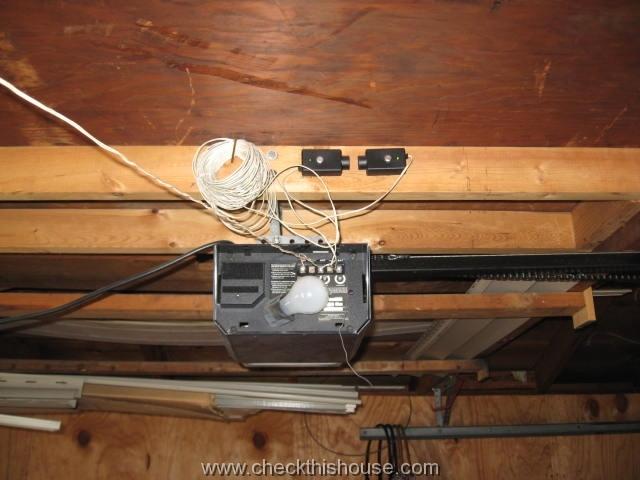

 What you see on the first 2 pictures is unfortunately a very common installation – two sensors taped together and secured above the garage door opener … the sensor on the third image should be lowered to its recommended location.
- Garage door opener safety edge sensor – commonly used on elevator doors, but also in some residential garage door openers – it’s a strip installed along the bottom edge of the door. When it detects pressure applied by any obstruction, it should stop and reverse the door.
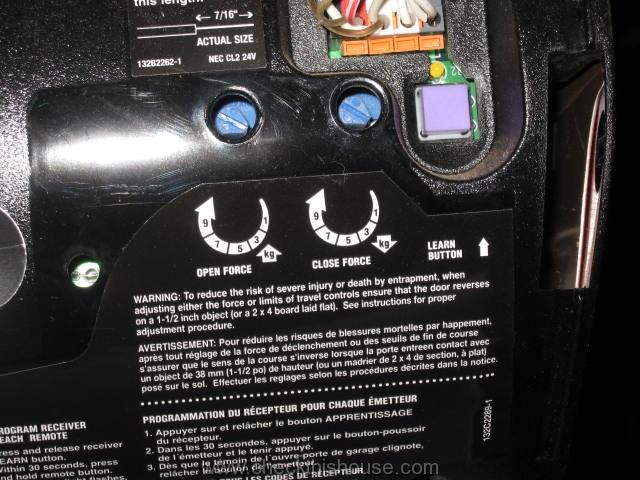 Another of the garage door opener safety features is a reverse on obstruction setting, which must be adjusted properly.
In case this is the only garage safety feature (no door edge sensor or photoelectric eye) – it becomes critical. It is also critical in situations where an electric eye has been improperly mounted (too high or in a different location – like on the pictures above).
There should be a couple of adjustment screws on the body of the garage door opener assembly, usually marked “down force” & “up force” or “open force” & “close force” (just like on the picture). Make sure, that you’re adjusting the proper set of screws, because many models of garage door openers will also have “up / down travel” adjustments – read the label.
Always follow manufacturers instructions when doing adjustment, if the paperwork is gone, look it up online for that particular model. The general rule is to place a 2″x4″ block of wood underneath the door and try to close it.
The garage door opener safety setting “up / down” force must be adjusted in such way, that when the door bottom edge touches some obstruction, it will immediately reverse. Some recommend using paper towels rolls instead of a wooden block, because it has a density similar to the human body, and especially small children. If you can get the garage door opener sensitivity adjustment that close, it would be perfect!
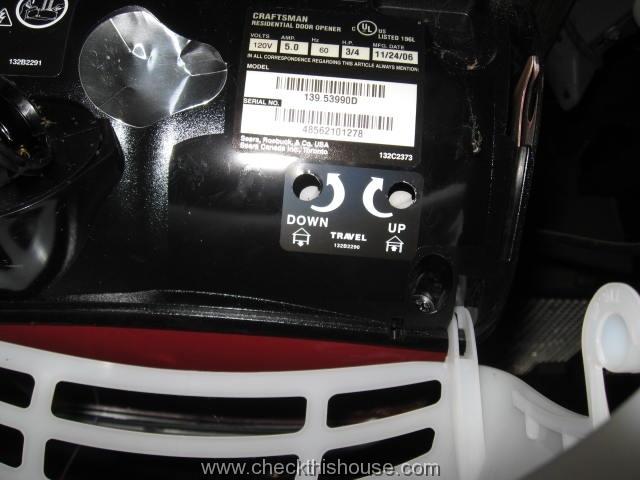
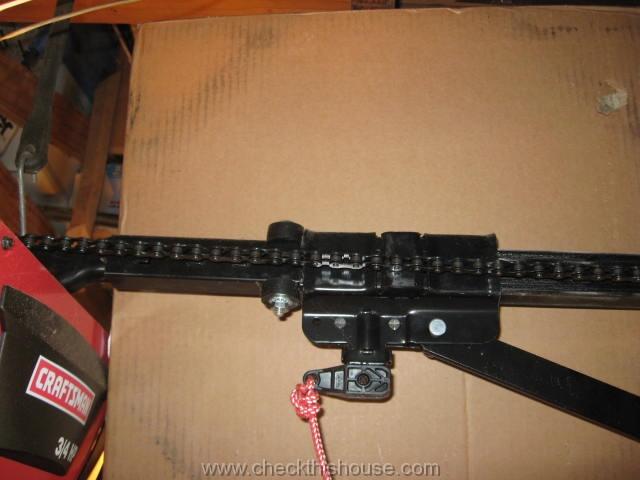 Garage door opener safety – Up / Down travel
This is also very important because overdoing it, often combined with an improperly adjusted Up – Down force, might compromise the garage door opener and the door itself.
Garage door opener safety – Down travel
It should be adjusted so when the door it is in a closed position – the bottom weather strip is slightly compressed (not crushed completely).
Garage door opener safety – Up travel
When the door is fully open, the garage door opener arm bracket should never hit the opener itself or a protective bracket / screw – at the most, it should stop right before it, without actually hitting it.
The garage door opener is not a crane – it’s a device that replaces your own hand in opening / closing process. What this means is that before the opener arm is physically connected to the door, you should make sure that the door spring tension has been properly adjusted and the door is equally balanced.
If you want to test the door already equipped with an opener, disconnect the opener arm only when the door is fully closed – be careful, because some door spring tension may be too high and it could pull the door up as soon as the opener has been disconnected.
Garage door opener safety tip
When springs are properly adjusted, you should be able to easily raise / lower and stop the garage door at any height, and it should remain at this level without any assistance – stay clear of the door path and don’t place your fingers between the door sections when performing any tests.
If the door is out of balance – doesn’t act like described above – call the professional to adjust it – this is a very dangerous procedure if you don’t know what you’re doing! Few more things:
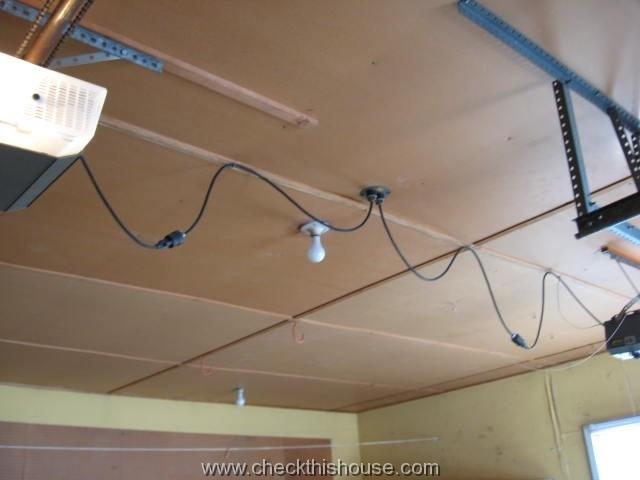
Garage door opener safety – garage door opener should be plugged directly into an electrical outlet, not an extension cord, not a light fixture socket.
Latest NEC (National Electrical Code) requires garage door opener GFCI protection Not necessarily a convenience if it trips on a high ceiling installation, but there’s an easy solution, just follow the link above.
 Garage door opener safety – any time you install the garage door opener, make sure that the upper door panel or door section (with single panel doors) has been reinforced – this applies to single and double garage doors. Reinforcement bar doesn’t usually come with the door, it is an additional piece of metal you have to pay for.
- For a single door, without the electric opener, it isn’t absolutely necessary.
- For a double door, I’d highly recommended one bar along the top, at least one more along the bottom edge, for heavy doors the third one might be necessary, and installed with or without the opener. Wide doors without the reinforcing bar start sagging after a while, and will most likely crack in the center of the top panel, right above the garage door opener arm attachment area.
Garage door opener safety – push button
Recommended installation is at about 60″ to prevent small children from playing with it, and in a location where you can see the overhead door when closing – Consumer Product Safety Commission
Garage door opener testing procedures:
- Garage door opener safety – On closed garage overhead doors, carefully disconnect the opener arm (some older models might not have a disconnect option) and test if properly balanced – if not call a professional to adjust it. Springs tension should be adjusted in such way, that overhead door can be operated by hand without the mechanical opener, stopped at any level and remain there without any support.
- Garage door opener safety – If operating properly without the opener, reconnect the arm and test it with a block of wood or better with a towel roll – adjust if it doesn’t reverse (if you open and close the garage door opener too many times while adjusting sensitivity it will overheat and stop responding until its motor cools down).
– If your garage door opener is malfunctioning or has improperly installed safety features – correct this potentially hazardous garage door opener safety condition immediately!
– If your overhead garage door opener has no currently required safety features – please replace it, it’s dangerous!
Comments are closed.