


• If you can see this link so can 1000's of other eyeballs every single day; advertise on checkthishouse.com
  • Home
  • About Me
  • Disclaimer
  • Virtual Help
  • Partners
    • Home Related
    • For your Home
    • Construction / Remodeling
    • Real Estate
    • Home Inspections
    • Internet Marketing
    • Home and Garden
    • Heating and AC
  • Contact
  • Q&A How to Ask
  • Advertising

Home Maintenance, Remodeling and Repairs

Home maintenance advice, home repairs, remodeling projects for home owners, buyers, from your Illinois home inspector

  • Attic
  • Electric
    • Electrical System Issues
    • GFCI / AFCI
  • Environmental
  • Exterior
    • Free Shed Plan
    • Grading / Drainage
    • House Roof
  • Foundations
    • Crawlspace
  • Garage
    • Car Garage Issues
  • House Maintenance
    • Fall Maintenance
  • HVAC
    • Air Conditioning System
    • Chimney Problems
    • Heating System
    • House Ventilation
  • Inspections
    • Chicago Condo Inspection
    • Crawlspace Inspection
  • Interior
    • Bathrooms
    • House Components Issues
    • Kitchens
  • Plumbing
    • Gas Water Heater
    • Plumbing Problems
  • Recalls
  • Safety
    • Carbon Monoxide
    • Handrails and Guardrails
    • Smoke Detectors
www.checkthishouse.com
You are here: Home / Garage / Car Garage Issues / Garage Door Springs Safety, Avoiding Serious Injury

Garage Door Springs Safety, Avoiding Serious Injury

  Written by Dariusz Rudnicki     Print This Post  

Garage Door Springs Safety


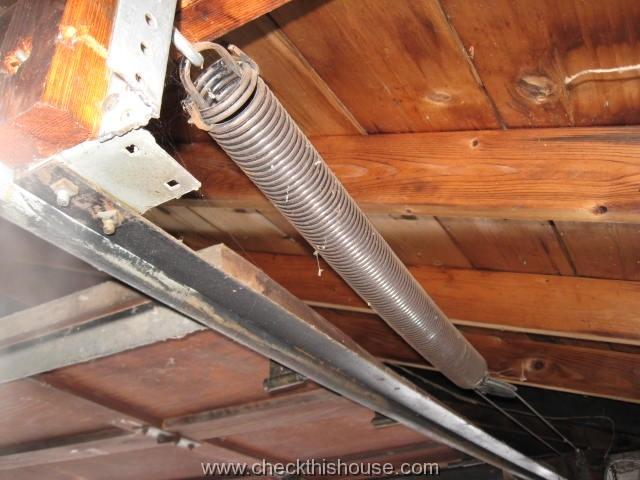
The overhead garage door springs safety cables missing

The major garage safety issue, and the most dangerous component of the overhead door is the garage door spring – (or springs depending on the design), which supports the entire weight of the door panels (sometimes over 400 pounds) and helps you to lift / lower the entire door assembly.

The overhead garage door is usually the largest mechanical thing around your house.

I have personally installed 3 overhead garage doors with 2 different types of  garage door springs and you do have to trust me on the following - garage door springs are under enormous pressure and you can get seriously injured or even killed when performing such work. If you decide to take your chances – it is imperative that you follow instructions to the last detail!

Even if you have a friend or a professional installing garage door springs for you, read the manual and check everything after installer finishes the job.

The garage overhead doors have no safety brakes (at least I haven’t heard about one), that would prevent it from falling down when the supporting spring fails. I’ve found some US patents for such devices, but apparently none of them was ever implemented into an actual garage door.

According to the US Consumer Product Safety Commission, garage overhead door related accidents account for thousands of injuries every year (average of 30000 per year). For example, these injuries are; fractures, crushings and amputations. It is believed that not all injuries are reported in the United States. (www.cpsc.gov)


There are basically two types of the garage door spring systems utilizing tracks / side rails (at least these are the most common types in Illinois and probably the rest of US):

1. Torsion type garage door spring(s)

Torsion garage door springs are wound-up on a rod above the garage door opening top section (door header)

2. Extension type garage door springs

Extension garage door springs are attached on either side of the door and stretch along the horizontal part of the track when the door is closed

You might also have an old, one piece door that swings outward as it goes up and overhead. This particular design will have garage door springs mounted on the sides of the door opening – at about your waist height, secured to a lever bracket system that extends the springs toward the ceiling at the door closing.

It is an old and extremely dangerous system, not manufactured anymore. If you have a such system in the garage, I’d highly recommend replacement.
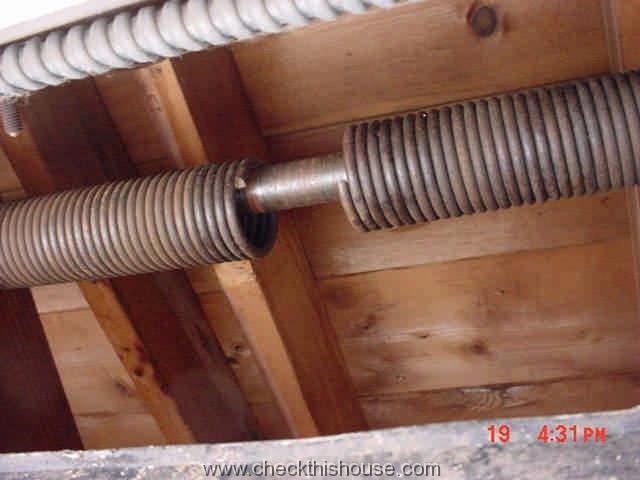
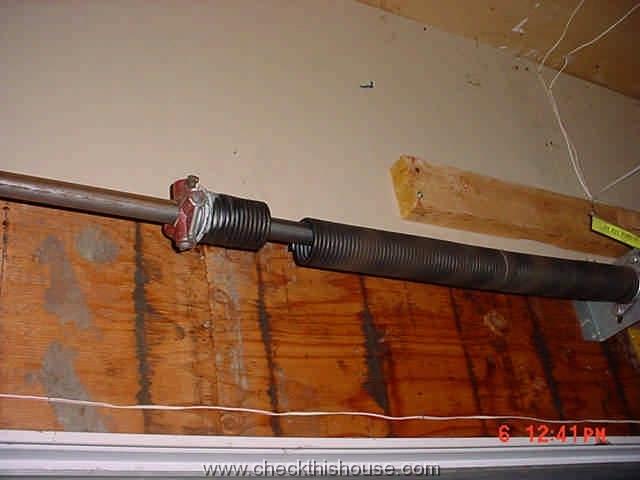
Overhead garage door springs safety - broken spring 1Overhead garage door springs safety - broken spring 2* Torsion type garage door springs come in either single or double spring designs. The spring will usually break while under the maximum stress which is when the overhead garage door closes / travels down, or it is already completely closed (USUALLY). If you’re closing it manually and it happens during this operation, don’t try to prevent it from crushing down, let it go and step / jump back as quickly as you can / make sure your foot is not where the door will slam!

When one of the two garage door springs breaks you need to have them both replaced at the same time! It will cost some extra money, but having an old and new spring installed will:

- put much more stress on the new one

- the garage overhead door will loose proper balance

- the remaining garage door old spring will most likely break soon

Torsion type garage door springs for residential overhead garage doors have anywhere between 5000 – 30000 cycles life span. Those digits represent an average total number o times you should be able to open and close your door before anticipating garage door spring replacement.
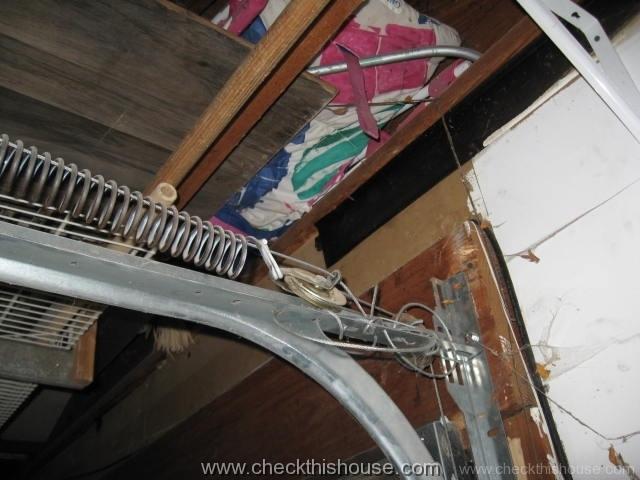
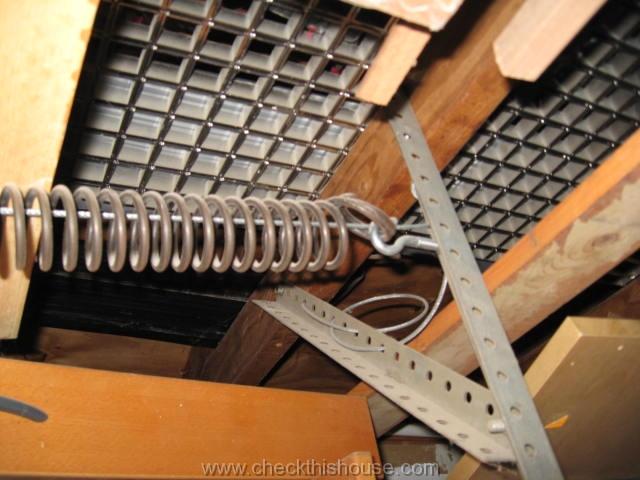
Properly installed garage door extension spring safety cable 1Properly installed garage door extension spring safety cable 2* Extension type garage door springs – you might have either one or two on each side of your overhead garage door.

A critical issue with extension type garage door springs is to have a safety cable installed inside of each single spring and secured properly, so when the door opens and closes, the spring can freely slide on this cable!


When the garage door spring snaps without the cable inside, broken ends might severely injure anyone standing within their range. The cables should be always included with the overhead garage doors hardware (assuming that they came equipped with extension springs), but A LOT OF PEOPLE either forget to install them, or don’t read instructions and maybe assume that they are not required.

Replacement of torsion type garage door springs – Manual

For more important garage tips check garage  fire wall, garage door opener safety, and garage door sensors posts – it’s important!

Go ahead and carefully test your garage door springs safety.


Search existing Q&A at: Car Garage Questions

More from Home Maintenance

  • GFCI Required Residential Locations since 2008 NEC Edition — Home Maintenance, Remodeling and Repairs
  • Garage Door Sensors | Overhead Door Opener Sensor Troubleshooting — Home Maintenance, Remodeling and Repairs
  • Garage Door Opener Safety Manual Bottom Line — Home Maintenance, Remodeling and Repairs

Home Maintenance Recommends

  • Techniques on How to Adjust a Garage Door’s Safety Sensors  (Web Chit-Chat)
Blog Margeting Related Posts Plugin For Home MaintenanceAsk Home Maintenance To Recommend Your Posts Blog Marketing Related Posts Plugin Counter

  • delicious Bookmark on Delicious
  • digg Digg this post
  • facebook Recommend on Facebook
  • linkedin Share on Linkedin
  • reddit share via Reddit
  • stumble Share with Stumblers
  • technorati Share on technorati
  • twitter Tweet about it
  • yahoo_buzz Buzz it up
  • rss Subscribe to the comments on this post
  • email Tell a friend
Filed Under: Car Garage Issues Tagged With: garage door extension springs, garage door spring, garage door springs, garage door springs safety avoiding serious injury, garage door torsion springs, garage spring, garage springs, home maintenance advice, installing overhead garage spring, torsion spring accidents
About Dariusz Rudnicki

I'm a retired Illinois home inspector, founder and editor of checkthishouse.com, a blog which attracts around 2 thousand readers daily and is dedicated to answering the many questions of home owners and home buyers.
Connect with me on Google+

  1. admin says:
    November 25, 2008 at 11:14 am


    You can try this one, it’s very detailed – http://www.wayne-dalton.com/files/Manuals/9000Extension-248437.pdf
    But, the best way would be to follow your particular door manufacturer installation guide.

  2. ahmad afsharnia says:
    November 25, 2008 at 7:29 am


    pls send us more detaile about replaceing of extension spring from torsion spring for garage sectinal door .

Trackbacks

  1. Garage Door Safety: Extension Springs | The Incidental Economist says:
    October 14, 2009 at 3:02 am


    [...] system is explained on a few websites (Check This House, Ezine Articles). Here’s a brief summary: run a cable down the middle of the spring and [...]

Sponsored Ads

  • www.checkthishouse.com

***Go to Home Maintenance Q&A section***

Sponsored Ads

www.checkthishouse.com
.

Home Safety Maintenance

House Maintenance Advice - Vocal Smoke Detector

Smoke Detector Safety Tips – is Your Life Worth at Least $10.00?

Second floor laundry chute mounted on the floor surface with a 9' drop underneath

Laundry Chute Hazard – a Convenient Way to a … Disaster

kidde carbon monoxide

Carbon Monoxide – Toxic Gas Without Taste, Smell or Color

The clothes dryer plastic vent is forbiden, any type of dryer vent should be as short as possible

Clothes Dryer Vent | Why is Dryer Vent Cleaning so Important

Perfect size and one of perfect shapes for the stairs handrail

Stair Handrails and Guardrails Safety Issues

Closet light safety - exposed incandescent light bulb is not permitted, too close to storage, poses fire hazard

Closet Fire | Closet Light Fixture Fire Hazards

Garbage disposal electrical wiring performed with a lamp cord, exposed bare wires, missing connection box cover

Garbage Disposal Wiring | Kitchen Disposal Safety

telesteps-telescopic-combiladder-fully-open

Telescopic Ladders Review – Watch Your Fingers!

Kitchen stove safety - single piece stove anti-tip bracket

Kitchen Stove Safety Anti Tip Bracket

House safety maintenance - climbable balcony guardrails are not permitted - watch your children

Balcony Railing Safety Code | Balcony Guardrails Safe for Children

***Go to Home Maintenance Q&A section***

Like us on Facebook

Search CheckThisHouse.com

Helpful links

  • A UTC Fire & Security Company
  • CDC
  • Consumer Search
  • CPSC
  • Energy Star
  • EPA – Environmental Protection Agency
  • Federal Pacific Electrical Panels
  • Going Green Basics
  • HVI – Home Ventilation Institute
  • IEMA
  • Mesothelioma Center
  • Nicor Gas
  • Peoples & North Shore Gas
  • Permit Place
  • Underwriters Laboratories
  • USFA
  • Zinsco Sylvania Electrical Panels

Sponsored Ads

  • Make Your Home Energy and Cost Efficient - FREE 37 Pages of Tips / instant download / no registration

Home Maintenance Alexa Stats

Recommend

Recommend [HomeMaintenance]

Home & Garden Blogs
bloglog
Connect with me on Google+

Last 7-days Popular Posts

  • House Water Heater Vent Pipe, How To Do It Right 2457 view(s)
  • Chimney Flue and Furnace / Water Heater Venting 1476 view(s)
  • Getting Rid of Mold in Your Attic| Killing Mold in Attic 641 view(s)
  • Attic Black Mold and Why is it Growing in Your Attic 595 view(s)
  • Code Requirement for Bathroom Vent Location | Bathroom Exhaust 587 view(s)
  • Where to Install Smoke Alarm Detector | Proper Smoke Alarm Location 559 view(s)
  • Attic Ventilation | How Many Attic Vents Your Roof Needs 527 view(s)
  • Plumbing Vent Problems in Your House | Sewer and Drain 510 view(s)
  • Saddle Valve Installation 496 view(s)
  • Carbon Monoxide Detector Alarm Locations | Where to Install CO Detector 438 view(s)

Last searched terms

  • - interior balcony railings heights
  • - getting rid of odors in heating ducts
  • - how to wire an on(...)garbage disposal
  • - gfci installation
  • - afci outlet receptacle
  • - asbestos floor tiles
  • - bathroom gfci wiring diagram
  • - laundry chute
  • - is it expensive t(...)place with pipes
  • - receptacle distance in kitchen

Visitors Currently Online

  • 03 visitor(s) online
  • powered by WassUp

Search CheckThisHouse.com

Return to top of page

Copyright © 2012 · Home Maintenance · Chicago Web Hosting · All Rights Reserved

  • follow:follow:
  • Become my Facebook friend Become my Facebook friend
  • Connect with me Connect with me
  • RSS RSS
  • Tweet with me Tweet with me
  • Subscribe to my YouTube Channel Subscribe to my YouTube Channel